Within the demanding world of contemporary pro-level oversteer competition, success is no longer purely a result of brute torque or driver courage. Instead, it has evolved into a complex science which demands a scrupulous fusion of picking a proven car, arming it with the correct drift-spec components, and, most critically, grasping its real-time performance on the track through cutting-edge drift telemetry software. This comprehensive manual will serve as your master plan starting from the initial concept of a drift build through to the last engineering-refined adjustments that turn a capable car into a repeatable podium finisher. We will thoroughly explore the art and science of chassis dynamics adjustment, illustrating how a advanced drift tuning app like a dedicated telemetry system eliminates assumptions and offers exceptional clarity into your car's actual dynamics.
The foundation of any great competitive sliding vehicle is, without question, the platform itself. Several cars have earned iconic reputation within the worldwide oversteer scene due to their built-in weight distribution, strong design, and the enormous range of aftermarket components available. Selecting the optimal platform is the first and most crucial selection a enthusiast will make. As an example, the the E36 generation BMW is commonly accepted as perhaps the the best overall cars for drifting of the modern era. Its excellent evenly distributed mass, coupled with a driven rear axle setup and extremely reliable straight-six powerplants, forms a car that is both accessible for beginners and incredibly effective in the control of a professional pilot. The next step of this philosophy, the BMW E46 platform, improves on these qualities with a even more sophisticated structure, increased wheel track for enhanced confidence, and yet more turning capability straight from the factory. A different powerful platform in the top-level arena is the C6 generation Corvette.
This V8-powered track weapon brings a unique set of benefits to the drifting discipline, featuring a light alloy frame, a transaxle-style drivetrain component that helps create an excellent front-to-rear mass ratio, and the colossal thrust of a big LS V8 motor. This fusion transforms it into an utter force on track, capable of entering and sustaining long slides with seemingly effortless application of acceleration. For drivers looking for exceptional value, the 350Z model Nissan excels as a prime choice. It is delivered from the factory with a rigid platform, a decent OEM limited-slip differential, and the smooth V6 motor that provides plenty of power and torque for learning and advancing in the activity. Its follow-up, the Nissan Z34, brings more improvements in structural rigidity, handling precision, and overall engine performance, establishing its place as a favorite choice among serious pilots. Additional historic cars that merit consideration are the agile unique FC generation RX-7, the most popular Nissan S13 240SX, the V8-powered SN95 generation Mustang, the more recent BMW E90, and the tiny yet unbelievably engaging and forgiving MX-5 Miata. Each of these cars gives a different palette of characteristics, difficulties, and possibilities, but they all share the core ingredients required to serve as a serious drift car.
However, choosing the optimal chassis is only the starting point. To unlock the full performance of any of these cars, major modifications to the steering system and chassis control systems are absolutely non-negotiable. This is where the realm of specialist drift-spec hardware comes into critical importance. The single most impactful modification for a purpose-built drift car is the installation of a drift-spec drift angle kit. These advanced assemblies, for example those developed by industry leaders like SLR, are designed to radically increase the vehicle's maximum turning lock. A standard street car is highly limited in how far its steering tires can rotate, a safety trade-off for public road driving. In sliding, but, extreme steering input is constantly required to catch and maintain a angle. An steering kit substitutes the OEM uprights, linkages, and sometimes control arms with pieces that allow the wheels to reach steering lock in excess of 70 or even 80 degrees, compared to a typical OEM setting of around 40 to 50 degs.
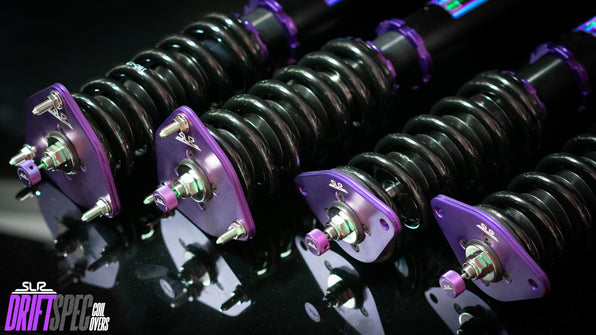
This tremendously expanded capability gives the driver with exponentially enhanced control during a drift, allowing it to be far easier to start a drift, maintain it through a long corner, and change fluidly from one direction to the opposite. The difference in controllability is absolutely profound. Coupled with a properly chosen angle kit is the equally essential enhancement to the chassis's damping system. Store-bought or even premium road adjustable suspension are just not designed for the particular and harsh needs of drifting. A purpose-built set of coilovers is paramount. These specialized suspension components feature custom damping rates and spring strength that are optimized for the violent load shifting that is inherent of sliding. When a pilot initiates a drift, the vehicle's inertia is transferred forcefully to the front of the corner. Correct drift-spec dampers control this shift in a predictable way, permitting the car to find its balance quickly and offering the driver precise response through the steering wheel and driver's seat. They furthermore allow for precise tuning of stance, damping firmness, and weight balance, which are all fundamental elements of fine-tuning the vehicle's handling to a specific track or driving technique. Together, a high-quality steering angle kit and a correctly selected system of competition adjustable dampers form the core hardware cornerstone upon which all later optimization is constructed.
Once the fundamental parts is fitted, the following essential step in the development is the precise adjustment of the chassis's suspension geometry. This is the domain of vehicle alignment optimization, a process that can feel intimidating to the uninitiated but is, in practice, the defining factor to converting a collection of high-performance pieces into a cohesive and consistent vehicle. The most discussed parameter of alignment for oversteer is certainly negative camber. Camber is the tilt of the rim relative to the upright line when looked at from the forward of the vehicle. When the top of the wheel is tilted towards the chassis, this is referred to as negative camber. For sliding, an inward tilt on the front wheels is universally applied and is regarded as necessary. The logic is fundamentally tied to vehicle dynamics.
When a vehicle is turning at high angles, the chassis leans towards the outside of the bend. This chassis roll makes the outside front wheel to lose its ideal contact patch with the tarmac. By applying negative camber, the tire is pre-leaned to counteract this tilt. As the chassis leans into the turn, the tire flattens out on the road surface, increasing its bite at the exact time when it is drift tuning app absolutely essential for steering authority. Commonly, drift tuning app front angles for a competition drift car vary from approximately -3 degrees to as high as -5 degrees or even more, depending on the details of the vehicle configuration, tire type, and operator style. The back tires also use inward lean, but the angles are typically more modest and more nuanced than the front. Excessive camber at the back can result in the chassis extremely prone to oversteer and challenging to control on acceleration input, as it reduces the usable grip area of the driven wheels during linear throttle application. Hence, rear adjustments are frequently in the range of -1 degree to -3 degrees, achieving a careful balance between providing adequate side traction to help in entering and maintaining the slide while simultaneously keeping good grip for power-down the bend. alignment is only one element of the more complex alignment puzzle, which furthermore encompasses toe setting, caster, and suspension-induced steering adjustment.
Toe is the direction of the tires as seen from above. Inward toe means the front edges of the tires are closer together than the trailing edges, while negative toe means the reverse. For drifting, a slight amount of front toe out is often run to sharpen the turn-in steering reaction, making the car feel more nimble and ready to initiate a oversteer moment. Rear toe angle is usually set to neutral or a very minute amount of toe-in to encourage straight-line stability under throttle. caster angle is the forward or rearward angle of the steering axis when observed from the side-on of the chassis. Positive positive caster enhances steering feel and stability solidity, and it also boosts camber gain during turning, which is extremely useful. Adjusting these settings is a detailed dance where a change to one parameter can and will impact the remaining parameters. The traditional approach for setting a chassis's alignment for drifting has for a long time been a labor-intensive process of experimentation and feeling. A tuner or crew would introduce a change based on experience, run the car on track, use the pilot's individual perception and comments, and then apply another adjustment. This loop would continue again and again until the vehicle felt "right" or the available testing period was exhausted. This approach is not only exceptionally wasteful in terms of man-hours and tires, fuel, and parts, but it is also fundamentally imprecise.
Pilot perception is a infamously subjective metric, influenced by countless variables such as fatigue, evolving track conditions, ambient heat, and just the focus of the operator on that specific run. What feels "oversteery" on one pass might feel "tight" on the subsequent lap, leading to confusing information and counterproductive tweaks. This long-standing challenge in car suspension tuning is specifically where contemporary engineering tools has stepped in to transform the process.
The development and adoption of advanced suspension tuning applications has brought about a new age for building and refining competitive drift machines. These tools, showcased by groundbreaking systems like modern telemetry hardware, function by actively capturing the actual physical movement of the chassis as it is operated on the track. In contrast to using subjective impression, these devices acquire objective information on essential parameters such as shock absorber movement, wheel speed, G-force loading, lock position, and accelerator and brake pedal position. This acquired data stream is then processed by advanced algorithms that can plot and interpret the information in a clear way. For the very first time, drivers and builders can observe precisely what the vehicle is performing at any given moment of a lap. This function revolutionizes the complete chassis setup process. Consider the specific challenge of dialing in the front axle negative camber for a given vehicle. As an alternative to introducing a modification from -3 degrees to -3.5 degrees and then running many runs to try and "sense" a change, a vehicle dynamics tool can deliver immediate and definitive data. The application can show graphically how the tire's loading is acting during the most important stages of a drift: the initial flick, holding the angle, and changing direction. It can show if the current camber setting is permitting the steering tire to keep optimal loading or if the rubber is overloaded on its external shoulder.
The system can then suggest empirical recommendations for modification. Perhaps the data reveals that the tire is even stressing its outer shoulder at -3.5 degrees of negative camber, indicating that even more angle, say -4 degrees, might be beneficial. Alternatively, the data might show that the tire is not reaching temperature or that the inside shoulder is degrading excessively, which could indicate that there is too much angle and a slight decrease back to -3.2 degrees would be more ideal. This level of accuracy and practical intelligence was simply impossible in the era of solely seat-of-the-pants tuning.
The benefit of utilizing a advanced vehicle dynamics tool reaches far beyond just setting camber. It serves as an essential suspension tuning guide that is specific to your exact car. When fine-tuning the shock absorber settings on your adjustable dampers, rather than using vague tips or mimicking another car's numbers, you can use the software to analyze how the chassis is behaving in relation to your changes. The application can graph the suspension travel trace over a run, showing if the shocks are handling the chassis motion effectively or if they are allowing the car to bounce excessively after a direction change. It can assist in identifying problems like hitting the bump stops or losing droop, allowing you to apply educated choices to preload settings, damping settings, or ground clearance. This process translates just as well to the intricate process of suspension geometry optimization. Beyond camber, the software can offer data into how adjustments to toe and caster are influencing the chassis's handling during various maneuvers of a drift. For instance, it can assist you to determine the optimal amount of front axle negative toe for your particular steering setup and competition technique by analyzing the speed of turn-in reaction and the consistency of the vehicle at maximum lock. This turns the tool an incredibly useful drift suspension tuning guide that is constantly informed by the live performance of your own chassis on the circuit. It moves the drift suspension tuning guide complete project from a subjective skill into a methodical engineering procedure.
Moreover, the utility of a tool like data acquisition is not at all confined to expert teams with vast funding. For the amateur driver, it functions as an amazing force multiplier. It in essence provides the tuner with the knowledge of a professional suspension specialist without the corresponding overhead. It accelerates the tuning process by providing unambiguous directions to questions that would traditionally take countless track days of experience to answer. A tuner can see how their specific car reacts to specific inputs, building a more profound knowledge of vehicle dynamics in the endeavor. It additionally opens up advanced performance tuning concepts, allowing anyone with the desire to optimize their vehicle to accomplish it in a efficient and successful manner. This is particularly important in a discipline like sliding, where tuning know-how has traditionally been a highly secretive advantage among professional crews. In the modern era, that power can be in the garage of every serious driver.
In summary, the path to engineering and tuning the ultimate competitive drift car is a multi-stage mission that smoothly integrates time-honored mechanical wisdom with revolutionary digital solutions. It starts with the strategic selection of a legendary car, then built upon the installation of non-negotiable competition hardware like high-performance steering angle kits and properly valved drift-spec suspension units. The build then advances into the intricate stage of alignment optimization, where values like camber, toe setting, and caster are carefully set to match the chassis's upgraded hardware and the pilot's individual needs. Ultimately, and what really separates the contemporary process from the past, is the adoption of a powerful drift telemetry software. This platform eliminates the guesswork and waste of purely subjective setup by giving quantifiable, actual telemetry on how the vehicle is actually performing. It serves as an unparalleled engineering partner, a definitive coilover setup manual, and a master chassis development system. Together, this complete philosophy guarantees that every component of the competition vehicle—from the pick of the platform to the most minute click on the suspension—is optimized for peak success on the track. It signifies the full progression of the discipline of oversteer driving, bridging physical pilot talent with precise vehicle setup to build the perfect effective vehicles attainable.